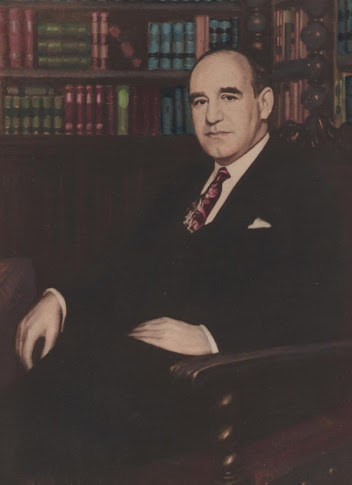
GUSTAVO GUTIERREZ Y SANCHEZ

Cuban Lawyer, Jurist, Politician, Diplomat, Economist.


1895-1959

Speaker of the House, 1940 (portrait by Valderrama)

Jurist Politician Diplomat Economist

Professor of International Law, School of Law, University of Havana-1919-1934.
Secretary/treasurer-Cuban Society of International Law, 1920.
Legal Counsel to Secretary of State-1925-29
Delegate- VI American International Conference, 1928
Delegate/Technical Counsel-Conference on Conciliation and Arbitrage, Washington-1928
Secretary General-First Pan-American Conference of Municipalities, 1928
Delegate Plenapotentiary-Conference on Trademarks, Washington, 1929
Director of the International American Office for the Protection of Trademarks and Commerce, 1930.
Liberal Party - President-Havana province, 1930
Delegate-IV Pan-American Commercial Conference, Washington, 1931
Secretary of Justice, 1933
Member-House of Representatives, 1938-1942
Technical Advisor-Commission on Foreign Relations for the Senate, 1937
Technical Advisor-Commission for the Study of the New Constitution, 193?
President of the Foreign Relations Commission for the House of Representatives, 1939
Technical Director -Pan-American Commission for Intermuncipalities Cooperation, Chicago-1939
Delegate- VIII American Scientific Congress, Washington-1940
Speaker of the House of Representatives, 1940-1941
Cuban delegation head and Sub-Committee President, United Nations Relief and Rehabilitation Administration (UNRRA) Atlantic City, 1943, 1944 and 1945.
G.A.T.T. Chairman Legal Drafting Committee and Tech. Dir., Cuban Delegation) Geneva-1947; (Head of Cuban Delegation) Geneva, Petropolis-1950, 1954.
Head of Cuban delegation, (GATT) Havana Charter, 1948.
President-Junta de Economia de Guerra, 1942.
President-Cuban Maritime Commission, 1942-43.
Ambassador to the United Nations (Security Council)1948.
President-Cuban Delegation, General Assembly, 1949
Technical Director/Secretary/President-National Junta of Economy (Junta Nacional de Economia) 1948-1953.
President-United Nations Economic Committee, 1951.
Minister of Finance (Ministro de Hacienda) 1953-1955.
Special Envoy-O.A.S. Conference of the Presidents, Panama, 1956.
President-Cuban Nuclear Energy Commission, 1956.
President-Ministerial Commission for Tariff Reform, 1958.
Minister of Economy (a.k.a. Ministro Presidente-Consejo Nacional de Economia/National Board of Economy, 1955-1959.

Legislator

(See blog entries Curriculum Vitae, October 2008 and Bibliography, June 2008)

Author

(See blog entries Curriculum Vitae, October 2008 and Bibliography, June 2008)

October 29, 2008

Crematística Nacional (Vocero Occidental-abril 17, 1954)


The Newspaper Vocero Occidental wrote an article about Gustavo Gutiérrez, Minister of Finance, on April 17, 1954. The title, "Crematistica Nacional" refers to a government's financial and monetary negotiations. Crematistica refers to the grouping of knowledge and studies regarding the production and the distribution of wealth.

The writer states that Gustavo Gutiérrez, with a brilliant history as a politician, financial expert, and eminent jurisprudent, is not an advocate of "parasitical budgets," but rather, budgets that are functional and practical. "He has earned the confidence of the people and the good faith of Major General Batista. All of the laws that this great Minister of Finance has implemented have solidified the reputation of the nation, placing him on a tripod of honesty, good reputation and hard work which instills confidence and promotes good faith in he who contributes to and borrows from the State. For without these qualities no government can prosper."

The writer adds that Gutiérrez's past experience in the National Junta of Economy will help him in the task ahead, preparing a vast plan of national finance (State budget), increasing the country's quantitative earnings as a result of practical and honest investments, all of which will greatly benefit the people and the nation. He continues saying this present Minister of Finance (GG) fought his first civic battles when he began to shine within the ranks of the revolutionary youth of the so called "Veterans and Patriots" movement headed by General Carlos Garcia Vélez, son of (Cuba's Independence War hero) General Calixto Garcia. Gustavo was also the "voice of gold" (great orator) of the revolution of that time which was won due to the great abilities of President Zayas.

"Since then the nation has never again been able to do without the services of this great statesman; upright, talented, well inspired and often triumphant. From these statements we find good proof of his parliamentary conduct, presiding over the House of Representatives, being elected without sinful compromises..."

" It can be said that Gustavo Gutiérrez is a statesman through and through because not only does he shine as lawyer, professor, parliamentarian, constructive man of revolutionary ideas, functional economist and politician; he's also a great diplomat which he demonstrated in different sectors of the United Nations and specialized congresses."

"For the good of the national economy and the honor of Cuba we hope that Gustavo Gutiérrez triumphs with the same elegance and patrician majesty that he has us accustomed to for some time now especially during these troubled times that humanity presently faces."

October 26, 2008

The Havana Charter (Carta de La Habana) 1948


In the picture above we see Ambassador William Clayton and Ambassador Gustavo Gutiérrez signing the Havana Charter (La Carta de La Habana) for the United States and Cuba, respectively in March, 1948. The Havana Charter was a document that followed the creation of the G.A.T.T. (General Agreement on Trade and Tariff), in Geneva, Switzerland in 1947, which attempted to, among other things, correct certain trade inequalities between the underdeveloped nations and their industrialized neighbors. Dr. Gutiérrez was in charge of hosting this conference in Havana which celebrated 800 official sessions. (please see blog entry " GG Prepares Capitol Building for International Conference," January 2009). Gustavo Gutiérrez had initially served as the Technical Director for the Cuban delegation in Geneva in 1947 as well as in New York and London. Then served as host and head of the Cuban delegation for the Havana Conference beginning December 21, 1947. For Dr. Gutiérrez closing remarks at the conference please see blog entry from February, 2010, "Havana Charter GG closing remarks 1948." Later he served as the head of the Cuban delegation in Geneva and Petropolis in November of 1954. See blog entry from October, 2008, "Cuba's Voice in Geneva and Petropolis 1954."

The caption below the picture reads; "The United States and Cuba celebrate among the nations which signed the Final Act and the Havana Charter, represented by the heads of the delegations Mr. William Clayton, on the left, and doctor Gustavo Gutiérrez, on the right, "This will be an historic day in the world," said the North American sub-secretary. And the delegate from our government said, "Proof of equilibrium, reached in the Charter on Commerce, it's just that it doesn't satisfy anyone."

In a speech regarding the Havana Charter, Gustavo Gutiérrez declared;

(English translation below)

1) In Geneva, November 10, 1954; "La Carta de La Habana, laboriosamente discutida y negosiada por una de las reuniones económicas mas universales que se han efectuados, no fué ratificada por los que más obligados estaban a hacerlo, quedando los paises insuficientemente desarrollados a la intemperie del G.A.T.T., sin las contrapartidas equilibrizadoras. Lasexcepciones del Acuerdo General primaron sobre los principios, y su complicada maquinaria no ha podido ser plenamente utilizada por los paises insuficientemente desarrollados."

"En relación, por último, con la reorganización del G.A.T.T. por medio de un instrumento para las cuestiones de organización y otro para las regulaciones de aranceles y comercio, la experiencia de la Carta de La Habana nos hace permanecer a la expecativa. Puede de nuevo una parte recibir la aprobación de los parlamentos y otra no, creando una rara sensación, aunque ningún país puede juzgar a los demás de acuerdo con su práctica constitucional o parlamentaria..."

"Esperamos, Señor Presidente y Señores Delegados, que los fríos del egoismo no malogren la esperanza de que los grandes principios que inspiraron el Acuerdo De Ginebra de Aranceles y Comercio y La Carta de La Habana para una organización Internacional de Comercio puedan, al fin, desembarazarse de la tupida red de intereses creados que no los dejan brillar con toda la fuerza que deseamos los que aquí nos encontramos y que, sin duda, esperan todos los pueblos de la tierra."

(English Translation)

"The Havana Charter, laboriously discussed and negotiated by one of the most universal economic meetings ever held, was not ratified by those who were most greatly obligated to do so. The underdeveloped countries remained out side of the G.A.T.T. without counterbalancing provisions. The exceptions of the General Agreement over-ruled it's principles and the under-developed countries have not been able to fully utilize it's complicated machinery."

"Finally, with regard to the reorganization of the G.A.T.T. by means of an instrument to deal with organization and another for the regulation of tariffs and trade, the experience of the Havana Charter makes us assume an expectant attitude. Again, it might be that one part will be approved by Parliaments while another may not, creating a rare situation, in as much as no country may judge the others according to it's own constitutional or parliamentary practice..."

" We hope, Mr. President and Fellow Delegates, that cold egoism will not defeat the hope that the great principles which inspired the Geneva Agreement on Tariffs and Trade and the Havana Charter for and International trade Organization may, in the last analysis, divest themselves of the thick network of created interests, which prevent them from exerting the force those of us here desire and which the peoples of the world expect."


2) In Petropolis, November 24, 1954; " Es justo reconocer que la iniciativa de los Estados Unidos se celebró en 1947 una Conferencia Mundial de Comercio y Empleo con objeto de liberalizar el comercio y propiciar el empleo, pero la realidad es que la Carta de La Habana para la Organización Internacional de Comercio, producto de las laboriosas y extensas discusiones de dicha Conferencia, no fué ratificada por el Senado de los Estados Unidos, y que el Acuerdo de Ginebra sobre Aranceles y Comercio (G.A.T.T.), que fué el único producto vivo del referido proyecto, ha funcionado más en beneficio de lo países industrializados de amplio comercio internacional, a pesar de ser una minoría en recursos nacionales y población, que de los países insuficientemente desarollados."

(English Translation)

"It is fair to recognize that on the initiative of the United States a World Conference on Trade and Employment was held in 1947 for the purpose of liberalizing trade and propitiating employment, but the fact is that the Havana Charter for the International Trade Organization, the result of laborious and lengthy discussions at said Conference, was not ratified by the United States Senate, and that the Geneva Agreement on Tariffs and Trade (G.A.T.T.), which was the only actual living result of that project, has operated more to the benefit of the industrialized countries with great international trade in spite of being in the minority in national resources and population, than to underdeveloped countries."

October 25, 2008

National Postwar Commission (Comisión Nacional Postguerra) 1944


This photograph appeared in the newspaper El Mundo on Wednesday, August 9, 1944. According to Dr. Gutiérrez's resume (see blog entry Curriculum Vitae) his position was that of Secretary of this Commission. The purpose of this Commission was to address Cuba's concerns at the upcoming Conference on Peace and Security in Washington, D.C. In a speech he gave in  Petropolis, Brazil 10 years later (see blog entry Cuba's Voice in Geneva and Petropolis 1954) one of his concerns regarding post war Latin America was that it's economy was placed at a disadvantage vis a vis the industrial nations. Gutiérrez lamented that the United States, after asking that it's Latin American neighbors, in solidarity with the Allied forces, maintain their war time export prices at pre war levels, did not return the favor after the War but instead raised it's export prices to Latin America. The United States grew richer as a result of the Second World War while Latin America grew poorer he says. He adds (English translation); "The present state of economic relations among the American countries is not entirely satisfactory. And this is not due to mere capriciousness but to very hard and realistic reasons regarding trade relations. As long as we do not try to mitigate in some way the adversity of that relationship for almost all the Latin American countries, as a result of exporting raw materials at low prices...and importing products generally at high prices, which are almost never under control, we very sincerely doubt that we are making any progress in the right direction."

English translation of photo caption: "The National Commission for the study of the problems of the postwar convened last night to decide what our country should suggest taking to the Conference on Peace and Security which will take place in Washington when the small nations are invited after the three great powers, England, Russia and the United States reach an agreement and China has been informed of their resolution which will be ratified. Those present were First Minister Doctor Alliegro, the Chancellor, Dr. Mañach, (invited as delegate representing Dr. Grau San Martin and possible future Minister of the Exterior), Dr. Guillermo Belt, Dr. Gustavo Gutiérrez, engineer I. Montoulieu, Dr. Dorta Duque, Dr. Cosme de la Torriente and Dr. Enrique Guiral."